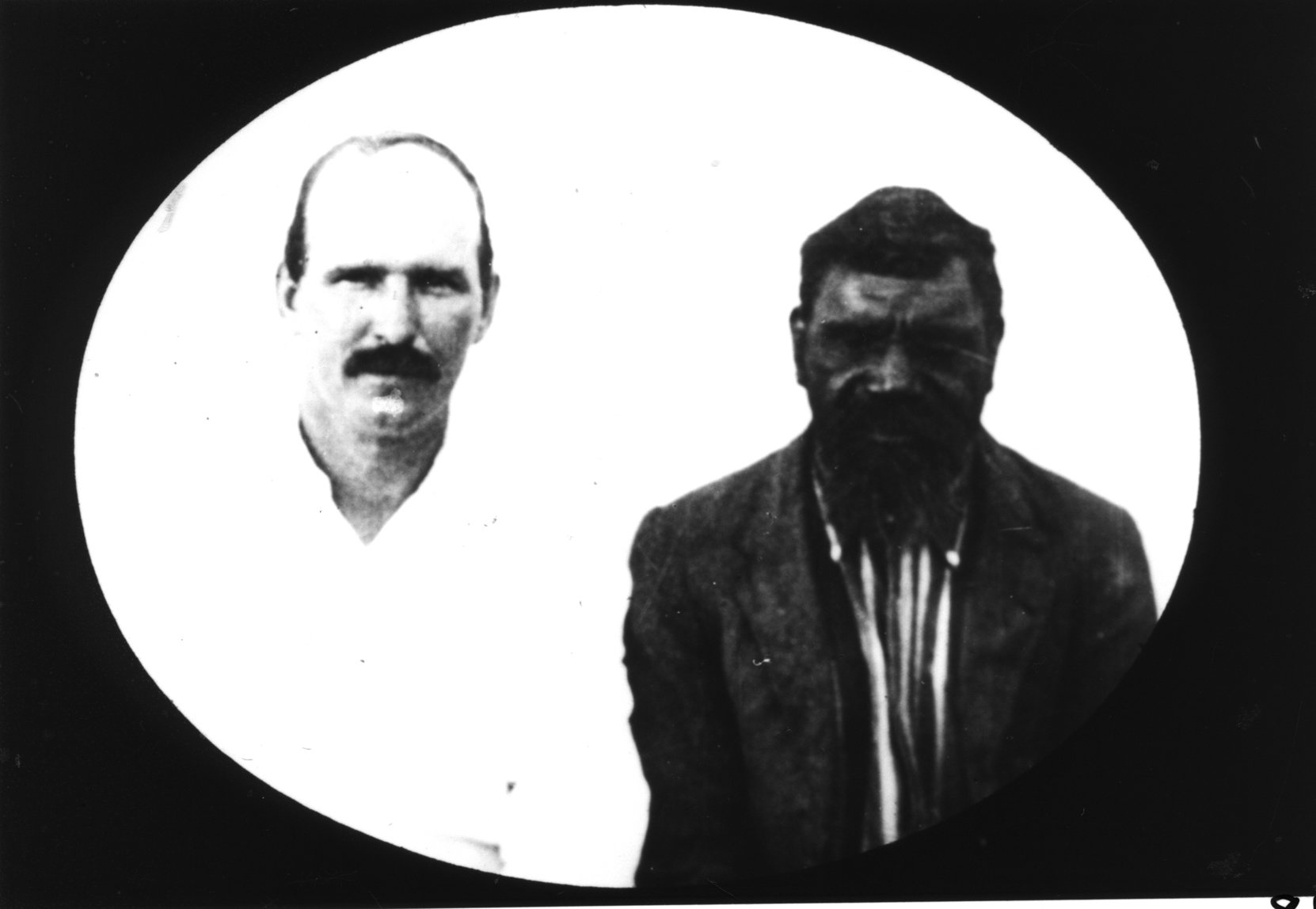
This image, held at the Museum of South Australia, shows the school teacher Heinrich with an unidentified Aboriginal man.
According to a biographical account written by Heinrich's daughter, Illona Oppenheim, Heinrich taught at Hermannsburg School from 1917-32. His decision to teach at Hermannsburg came in the wake of the S.A Government's decision to close all school's run by the Lutheran Church. Anti-German sentiments were rife during the late war years and many institutions with German connections were forced out of business. Heinrich had been a teacher at the Nain School near Greenrock in the Barossa Valley from 1912 until the school's close in July (Oppenheim, 5). Instead of joining the public school system he took up a position at Hermannsburg as head school teacher.
To get to Hermannsburg, Heinrich travelled by train to Oodnadatta and then some 700 kilometres by camel to Horseshoe Bend and then finally along the Finke to Mission Station.
Unlike most of the other staff members at Hermannsburg, Heinrich was unmarried when he arrived at the station. Mission staff were generally required to be married before taking up their posts in order to provide a good example of a 'Christian' life, but as the years passed, it became increasingly difficult to find married couples who were willing to live in a such remote part of the country.
In 1920, the Finke River Mission made a concerted effort to find Heinrich a wife. Heinrich was not unreceptive to the idea, however, he was not content to be matched up with a woman he hadn't met. In a letter Pastor Lieber, dated 25 November, 1920, Heinrich writes:
'...nobody would be more pleased than me to be a happy married man. But as it is, I would never leave up here just for the sake of getting married & I do not know of any girl who would marry me & live up here away from civilisation! At least none that I could love...So that is the problem & nobody would be more pleased & happy than myself if you, or anyone could solve it for me. I quite realise that my place here should be filled by a married man. You know that I have had at least one try but unfortunately my dreams were shattered. Now honestly speaking you could not expect me to come (4) down & get married to a girl I've never seen! Place yourself in my position & let me know your opinion. You better make up a list of all you think would come up bush & its discomforts & share life with a poor teacher & send it up to me for consideration (Heinrich, 5).
Heinrich eventually married in 1924, and as Oppenheim recounts, he went down to South Australia to bring her back to the station. The newly weds travelled by train to Oodnadatta and then from the railhead to Hermannsburg in the Mission buggy, which was driven by Albert Namatjira (Oppenheim, 5).
According to Oppenheim, when Strehlow died in 1922, the Aranda people gave Heinrich the name of 'Aijua', which means 'old man'. Mrs Heinrich was called 'Kunkai', which means young girl (Oppenheim, 6).
The legacy of Heinrich's work in Hermannsburg has been controversial....
REFERENCES
H.A. Heinrich, 'Letter to Lieber Herr Pastor' 25 Nov, 1920, trans. Kurt Kapitola, April 2005, Finke River Mission Correspondence with Hermannsburg, 1919-20, Lutheran Archives