|
Relationship Type, Dates and Annotation
|
  |
|
Relationship Type, Dates and Annotation
|
|
Relationship Types
Relationship types are defined within Heurist and can be selected from a pulldown list, as shown:
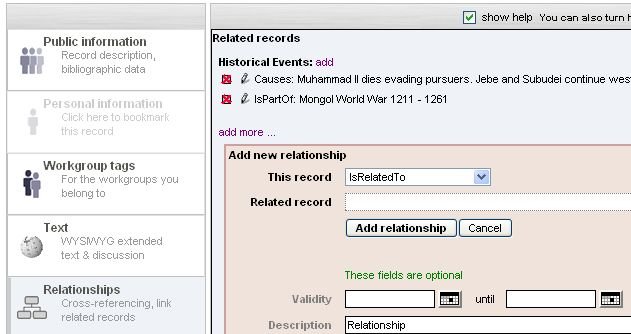
Additional relationship types can be defined by an administrator (contact to request additional relationship types on the main instance of Heurist, or add relationship types through the record type definition function if you are an adminstrator of your own instance). See Also:Record Types
Relationship types can also be imported from a file or RDF definition.
Reciprocity
Where a relationship type is directional (e.g. Causes, IsParentOf) the reciprocal relationship is automatically created (if A Causes B, then B IsCausedBy A)
Relationship Dates
These fields are optional and can be a means of recording the period for which the relationship was valid.
Multiple Relationships and Annotation
There is no reason why two records cannot have several relationships, which may reflect alternative views on the relationships between the records, or relationships which have different time periods. For instance, scholars may disagree on the start and end dates of a relationship or a person may be employed by the same institution on more than one occasion.
A relationship record is simply a normal Heurist record and it can be searched for and edited like any other record. This means that it can be annotated with text or a discussion such as questions of historical interpretation, its ownership and visibility can be set, it can be tagged and so forth, like any other record. This can be extremely useful with historical data in order to represent differing views or to tag set of relationships in order to present a cluster of events in a timeline.
By default, relationship records receive a generated title of the form: ID xxxxxx RelationshipType ID yyyyyy However this generated title can be edited to something more informative.
See: Terminology - Relationship Type